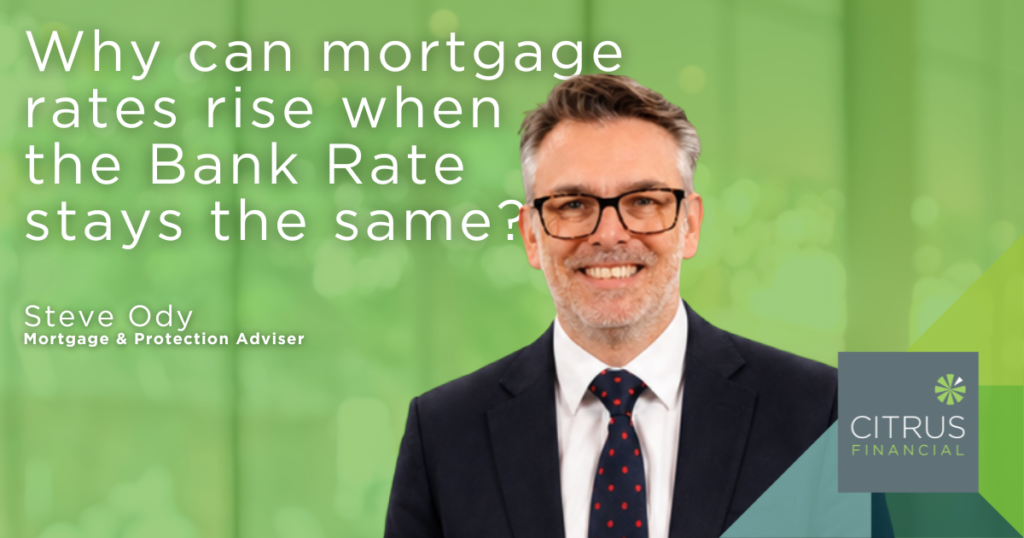
Bank Rate is an important influence on mortgage pricing, but it is not the only one. Steve Ody explains why lenders can increase fixed mortgage rates even when the Bank of England decides to leave rates unchanged.
By Steve Ody, Mortgage & Protection Adviser at Citrus Financial
When the Bank of England announced that Bank Rate would remain unchanged at its July meeting, some borrowers may reasonably have expected mortgage rates to remain unchanged too.
Yet around the same time, a number of lenders were increasing rates or withdrawing mortgage products.
So why does that happen?
The simple answer is that Bank Rate is only one of several factors lenders consider when setting mortgage rates. The relationship also differs depending on whether you are looking at a tracker mortgage or a fixed-rate deal.
What is Bank Rate?
Bank Rate is the interest rate set by the Bank of England. It influences borrowing costs across the economy, including mortgages, loans and credit cards, as well as the interest paid on savings.
At its July 2026 meeting, the Bank of England kept Bank Rate at 3.75%. However, three of the nine members of its Monetary Policy Committee voted to increase it to 4%.
The Bank also highlighted continuing uncertainty around energy prices and inflation. This helps explain why financial markets remained unsettled even though Bank Rate itself did not change.
Tracker and fixed mortgage rates work differently
A tracker mortgage will normally move in line with Bank Rate, usually by a set percentage above it.
Fixed mortgage rates work differently.
A fixed rate gives a borrower certainty over their interest rate for a set period, often two or five years. To provide that certainty, lenders pay close attention to what financial markets expect borrowing costs to look like over the relevant period.
This is where swap rates become important.
What are swap rates?
Swap rates are one of the measures lenders use when managing the cost and risk of offering fixed-rate borrowing.
In simple terms, they reflect what financial markets expect interest rates to be over a particular period. A two-year swap rate is relevant to the pricing of two-year fixed mortgages, while a five-year swap rate is relevant to five-year deals.
Swap rates can rise when markets become more concerned that:
- Inflation may remain higher for longer.
- Bank Rate may need to rise in the future.
- Interest rates may fall more slowly than previously expected.
- Economic or political events could increase future borrowing costs.
They can fall when markets become more confident that inflation is under control and rates are likely to decrease. This means fixed mortgage rates can change before the Bank of England makes a decision. They may also move in a different direction from Bank Rate.
Why did mortgage rates rise after Bank Rate was held?
Financial markets usually form an expectation about a Bank of England decision before it is announced.
If markets already expected Bank Rate to remain unchanged, that decision may have been largely reflected in mortgage pricing in advance.
What matters next is the outlook.
When some members of the Monetary Policy Committee vote for an increase, or concerns emerge about energy prices and inflation, markets may begin to price in the possibility that rates will remain higher for longer.
That does not mean Bank Rate will definitely increase. It means the cost and perceived risk of providing fixed-rate lending may have changed.
A lender increasing its mortgage rates is therefore not necessarily reacting to the latest Bank of England decision alone. It may be responding to a wider change in expectations.
What else affects the mortgage rates lenders offer?
Swap rates are important, but they are not the complete picture.
The lender’s funding costs
Lenders obtain the money they lend in different ways, including customer deposits and wholesale financial markets.
If those costs increase, a lender may need to charge more for new mortgages.
Competition between lenders
Lenders compete for mortgage business.
A lender may reduce rates when it wants to attract more borrowers. If several lenders do the same, this can result in a period of falling mortgage rates without any change in Bank Rate.
The reverse can also happen. If a lender is already receiving enough applications, it may have less reason to offer one of the market’s most competitive rates.
Application volumes
A particularly competitive mortgage can generate more applications than a lender can process efficiently.
Increasing the rate or temporarily withdrawing the product can help control demand and maintain service levels.
The lender’s business plans
Different lenders may want to attract different types of borrower at different times.
One may be particularly competitive for first-time buyers with smaller deposits, while another may focus on remortgagers, landlords or borrowers with more equity.
The mortgage and the borrower
The rate available to an individual can also depend on:
- The size of the deposit or amount of equity.
- The mortgage compared with the property’s value.
- The type and length of the deal.
- The borrower’s credit history.
- The type and condition of the property.
- Whether the mortgage is for a home or buy-to-let property.
This is one reason the lowest rate seen in an advert may not be available or suitable for every borrower.
Does a lower rate always mean a better mortgage?
Not necessarily. The interest rate is important, but arrangement fees, incentives, early repayment charges and product restrictions can all affect the overall cost and suitability of a mortgage.
A lower-rate product with a substantial fee could cost more overall than a slightly higher rate with a smaller fee, particularly on a lower mortgage balance.
Your future plans also matter. The right mortgage for someone intending to stay in their home for many years may be different from the right option for someone who expects to move again relatively soon.
What can borrowers do when rates are changing?
Nobody can reliably predict exactly where mortgage rates will go next.
Rather than trying to time the market perfectly, it can be more useful to concentrate on the things you can control:
- Understand your likely borrowing position.
- Decide what monthly payment feels comfortable.
- Review your options early.
- Consider rates, fees and flexibility together.
- Avoid making a decision based on one headline rate.
Starting a mortgage conversation does not mean you have to apply immediately. It can simply help you understand what may be available and what changing rates could mean for you.
What if your lender reduces its rates after you apply?
Through Citrus Financial Rate Watch, we continue to monitor the rates available from the lender you have applied to while your application progresses.
If that lender introduces a lower rate on a suitable product, and making a change remains appropriate and practical, we will let you know. We will explain the available option and any implications, so you can decide whether changing product is right for you.
This does not guarantee that rates will fall or that a lower-rate product will become available. It does mean that we continue paying attention after the initial recommendation and application have been made.
Talk to Steve or Nicky
Steve Ody and Nicky Kirton provide mortgage advice for first-time buyers, home movers, remortgagers and landlords.
Whether you are ready to proceed or simply want to understand your position, we can help you consider the mortgage options that may be available.
Your home may be repossessed if you do not keep up repayments on your mortgage.
Approver Quilter Financial Services Limited. 06/08/2026

About the author: Steve Ody is a Mortgage & Protection Adviser at Citrus Financial. He helps first-time buyers, home movers, remortgagers and landlords understand their options and make informed decisions about their borrowing.
Steve is known for his friendly, practical approach and his ability to make the mortgage process feel clear and manageable. He also has strong ties to East Grinstead, having served as Town Mayor and supported a number of local community organisations and initiatives.